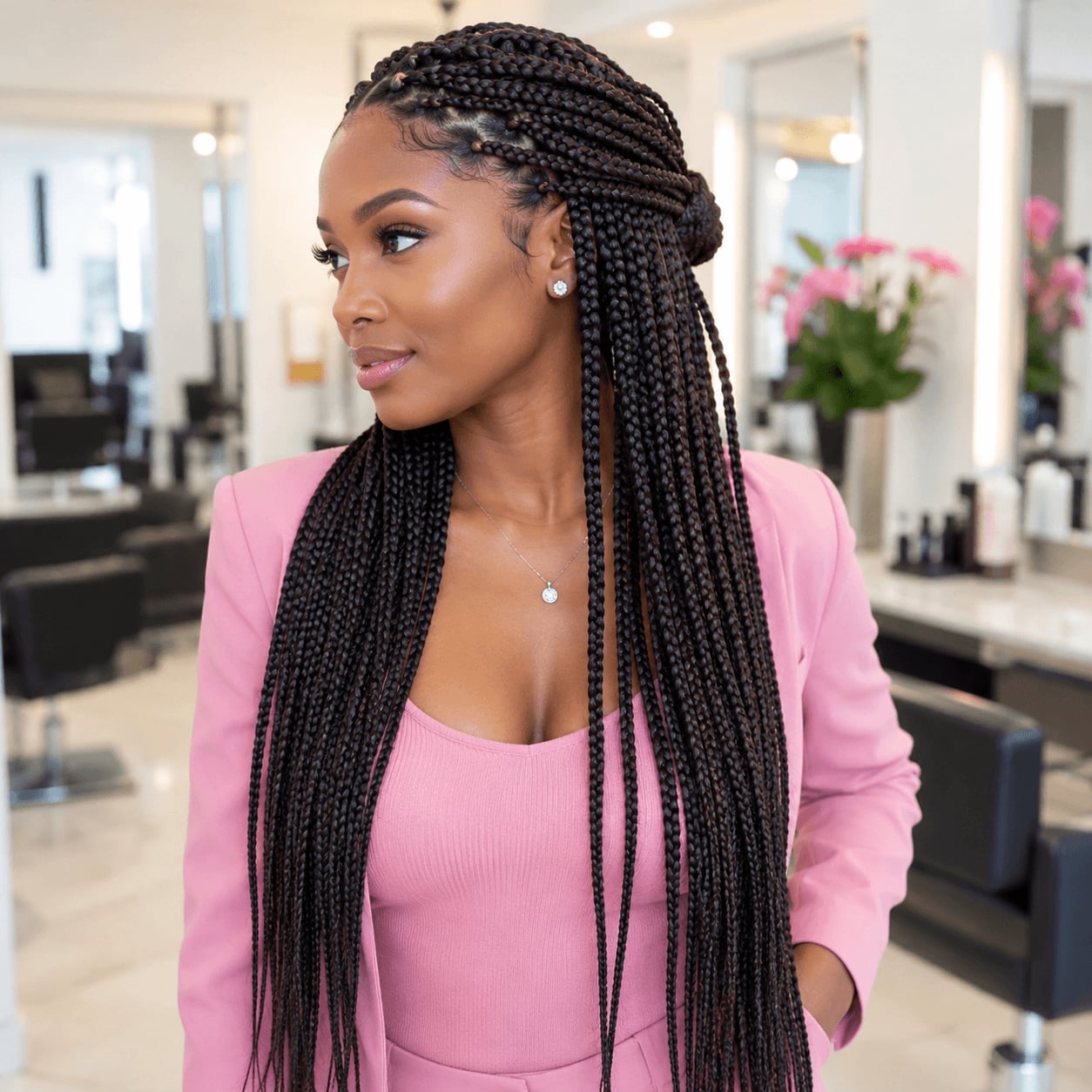
Braids have always been a foundation of Black hair care, blending protection with the kind of creativity that lets you switch up your look on a whim. Right now, the biggest shift is toward glossy, lived-in finishes that make the style look intentional without feeling overworked.
This collection of 20 braided styles for Black women covers everything from classic uniform parts to playful beads and mix-texture ends. Whether your hair is fine and needs volume or dense and needs a style that actually holds, each option comes with a concrete ask for your stylist, a realistic wear time, and the honest upkeep. No more guessing whether a style will last or just look good for a week.
Long Uniform Black Braids
A middle parting does the quiet work here: it splits long uniform black braids into two even halves that fall straight down the back. The braids are black, sleek, and identical in width from root to tip, which is why the finish looks polished instead of busy.
Ask your stylist for: long, uniform black braids with a middle part. This shape suits Afro-textured hair that already has some density, since thin braids on fine hair can look sparse by week two. A round face gets a lengthening effect from the middle part and the length past the shoulders. Styling is minimal: a light oil on the scalp and a satin bonnet at night keep the roots from frizzing. Book a takedown and rebraid every six to eight weeks.
Intricate Cornrows to Mid-Back Plaits

The parting pattern is the tell: cornrows fan out from the middle in tight, deliberate rows before releasing into thick plaits that hit mid-back. That front section takes the most time in the chair, because every row has to stay parallel while the braider works around the curve of the head.
Ask your stylist for: cornrows in front transitioning to mid-back plaits. Coily, thick hair holds the dense rows best, and the black color keeps the pattern readable instead of muddy. Expect about three hours for the front alone. Upkeep is simple: a fine-tooth comb separates plaits that start to mat, and a redo every six to eight weeks keeps the parting crisp.
- Bring a reference for the parting pattern, not just the length.
- Ask how many rows the front will take.
- Confirm the plait width before she starts.
Cornrow Front with Long Flowing Braids

Natural-hair cornrows keep everything flat against the scalp; this version lets curly extensions do the volume work past the shoulders. The decorative cornrow patterns at the front stay flat and graphic, then the long black braids drop into loose curls that move. Ask your stylist for: cornrows in front with long, curly braided extensions. It suits Afro-textured hair when you want length and swing without daily styling, and a light serum on the curly ends keeps the definition from collapsing into frizz.
Mid-Back Braids with Silver Beads

Small silver beads sit at the base of some braids, which turns a neat mid-back set into something with a little glint at the parting. The intricate cornrow pattern at the front stays flat and precise, and the black braids fall to mid-back in a clean middle part. Ask your stylist for: mid-back braids with intricate parting and silver beads. This wears best on Afro-textured hair with enough density to support the rows. Upkeep is where it gets real: frizz creeps in around the hairline first, so a light oil and a silk scarf at night buy you time. Plan a refresh every six to eight weeks, and brush gently so the beads do not snag.
Voluminous Curly Box Braids

Worried the curls will read as heavy? The volume is the point. These mid-back box braids carry a defined wavy, curly texture that gives the whole set a full silhouette, and the black color keeps it from looking busy. Ask your stylist for: voluminous, curly box braids to mid-back. Thick, Afro-textured hair handles the weight best, and a round face benefits from the length pulling things downward while the side volume balances a long face. A curl-defining cream keeps the texture from frizzing between washes.
Micro Braids with Loose Curly Ends

The magic here is the contrast: sleek, tight micro braids that give way to loose, defined curls at the ends. This style extends to mid-back, with an intricate middle parting that shows off the scalp art. The black color keeps it classic, while the baby hairs along the hairline are styled for a polished finish. Ask your stylist for: micro braids with loose curly ends and styled baby hairs.
Long Braids with Loose Wavy Ends

These long braids with loose, wavy ends offer soft, flowing movement, but the waves can unravel or frizz sooner than a straight end. For a style that stays crisp for weeks, this may not be it. The Afro-textured hair blends seamlessly with the black braids, and the middle part keeps it simple. Ask your stylist for: long braids with loose wavy ends.
This style looks natural and lived in, but expect to refresh the ends with a curling wand or flexi rods to keep the wave pattern past the first week. It is not a style you can ignore, but it moves beautifully.
Voluminous Braids with Curly Ends

These voluminous braids with curly ends are built for movement: the individual braids are sectioned neatly, but the loose, curly ends add a full, textured finish that extends past the shoulders. The Afro-textured hair and black color give it a natural feel. At night, the volume means you will want a satin bonnet or a pineapple to keep the curls from flattening. Ask your stylist for: voluminous braids with loose curly ends. A diffuser on low heat can help refresh the curl pattern without frizz.
Mid-Back Box Braids with Amber Beads

Amber beads at the ends of these thick, dense box braids add a festive touch for holidays, weddings, or any celebration where you want a little sparkle. The mid-back length and clear middle parting keep the style clean, and the black hair with amber beads gives it a warm, glossy finish. Ask your stylist for: mid-back box braids with amber beads. Make sure the beads are crimped tight so they do not slide off during the first week.
Box Braids with Metallic Beads

Adding metallic beads to box braids is a straightforward technique: the braider slides a bead onto the extension before sealing the end, then crimps it with pliers. This style, with long box braids and a middle part, feels simple but the beads give a subtle shine. Doing it at home is possible if you have the right tools, but a salon will ensure the beads sit evenly. Ask your stylist for: long box braids with metallic beads.
The beads add weight, so be prepared for a bit more pull on your scalp. Wipe them with a soft cloth to keep the metallic finish bright.
Shoulder-Length Box Braids with Gold Beads

Small gold beads sit scattered through the length of these shoulder-grazing box braids, catching light against solid black. The finish is blunt and the texture straight and thick, which keeps the silhouette clean instead of fuzzy. On a round face, the middle part and the length falling below the chin draw the eye down and add a little length. Long faces get more from the width the thick braids create at the sides. Square jawlines tend to suit the blunt tips, since a straight line at the end echoes the jaw rather than softening it.
Ask your stylist for: shoulder-length box braids with gold beads. If your hair is fine or low density, the weight of braids this thick can pull at the root, so a lighter braid count may serve you better. Straight, thick hair holds the smooth sections best. The beads are the one spot that needs attention: a fine-tooth comb run gently around them keeps the surrounding braid neat and stops the bead from sliding.
Collarbone Box Braids with Gold Hoops

Gold hoops threaded into box braids require planning, not improvisation. Ask your stylist for: collarbone length box braids with blunt ends, then specify the hoops separately, because the accessory is a choice the braider makes as the braid is built. These stop right at the collarbone in a blunt cut, black and thick in texture, with small gold hoops threaded through some of the braids. The middle part keeps it tidy. Say how many hoops you want and where they should sit, since placement is the difference between a detail and a distraction.
Neatly Done Shoulder-Length Box Braids

Clean sections and a crisp middle part do most of the work here, with thick black braids falling to the collarbone. Neatness is the whole design, and it is also the part that needs upkeep. A satin scarf at night protects the part and keeps the scalp sections from frizzing. Expect the edges to soften first, usually within a couple of weeks, so a light gel and a soft brush along the hairline bring the finish back. Ask your stylist for: neat shoulder-length box braids. Even tension during braiding is what keeps the rows smooth, so mention it at the appointment.
Neatly Parted Mid-Back Box Braids

Clean square parts at the scalp are what separate this from a rushed set of braids. Each section is squared off before the braid is built, and the parting continues straight through to the mid-back length in a solid black, straight and thick. A rat-tail comb is the tool for the job, since the tail keeps each line sharp as the next row starts. Get the parts uneven by a few millimeters and the whole pattern reads as crooked from the crown down.
Ask your stylist for: mid-back box braids with neat, precise parts. The grid matters more than the braid count: a consistent square at the root holds the shape for the length of the style. Straight, thick hair takes the tension well and keeps the sections flat. If you want the parting to survive the week, keep the scalp moisturized and resist the urge to pull the braids back tightly, which drags the parts out of line.
Long Flowing Box Braids

Where shoulder-length braids stay put, these move. Long box braids to mid-back swing with the head and catch light along the length, and the middle part lets them fall on both sides. The comparison matters when you choose: shorter braids are easier to manage day to day and cheaper in time at the salon, while mid-back length gives you more styling range, from a high pony to a half-up twist. If you want movement in the finish, this is the length that delivers it.
Ask your stylist for: long, flowing box braids to mid-back. Straight, thick hair holds the weight without the braids collapsing at the root. A light finishing spray adds shine without weighing the length down, and a loose tie at night keeps the braids from tangling against each other. The extra length means more braid to maintain, so plan on a touch-up at the root every six to eight weeks as your own hair grows out.
Collarbone Box Braids with Color Mix

Three tones in one braid is a lot to pull off without looking striped, and blunt ends are what keep it clean. Black, brown and blonde run through collarbone-length box braids, with gold accents on some, a middle part, and a soft light that catches every shade. Warm brown and blonde read best in fall light; the same mix feels brighter in summer. Ask your stylist for: collarbone box braids with black, brown, and blonde tones.
Shoulder Cornrows with Brown Highlights

A crisp middle part does most of the work here, and the brown highlights add subtle dimension. Shoulder-length cornrows in black with brown woven through sit sleek against the scalp, so the parting is the detail people notice first. Dense, thick hair holds the pattern best; fine hair can look sparse between rows. A middle part and length past the chin elongate a round face, while the flatness of cornrows keeps a long face from stretching further. Ask your stylist for: shoulder-length cornrows with brown highlights.
Cornrows with Loose Shoulder Curls

Cornrows with loose curls work by sectioning: neat rows at the front, then the back released into black curls that fall around the shoulders from a middle part. Curly, Afro-textured hair gives the back enough body to hold its shape. Ask your stylist for: cornrows in front with loose curls to the shoulders.
Cornrows and Curly Braids with Baby Hairs

Two textures in one style means two sets of rules, and the hairline is where they meet. Scalp cornrows lead into long curly braids that reach mid-back, all in black, with baby hairs laid along the front. The contrast is the draw and the upkeep: the cornrows stay flat while the curly braids need refreshing, and the baby hairs need re-laying with a soft brush and a touch of gel or pomade every few days. This is a salon build, not a kitchen-table job, and the takedown takes just as long as the install. This style requires regular maintenance. Ask your stylist for: cornrows leading to long curly braids with baby hairs.
Glossy Defined Dark Brown Twist-Out

Large, defined curls with a wet-looking sheen and a middle part: the twist-out is doing exactly what a twist-out should. Dark brown, thick and curly, it falls past the shoulders with loose strands framing the face. The length is the point here, because a twist-out only shows its pattern once the hair has enough room to coil. Ask your stylist for: defined twist-out with glossy, defined curls.
Wear reality: definition fades faster than length, so plan on retwisting in sections every few nights, which runs about twenty minutes. A hair butter or oil seals moisture and brings the shine back between washes. Loose strands around the face need a light finger coil, or they frizz first. A silk pillowcase stretches the set; cotton undoes it by morning. Expect a refresh every two to three days and a full redo every seven to ten.
Final Thoughts
For longevity, clean parts and moderate tension during installation make the difference between a style that holds for six weeks and one that needs redoing in three. Touch-ups every four to eight weeks keep the edges neat and the tension even.
- Protect braids with a silk or satin scarf or bonnet at night.
- Cleanse the scalp with a diluted shampoo or a scalp spray.
- Apply a light oil or serum to the length for moisture and shine.
- Avoid excessive heat styling to protect both extensions and natural hair.
- Schedule touch-ups every four to eight weeks depending on growth.
Braids offer a canvas for personal expression. Find the style that speaks to you.