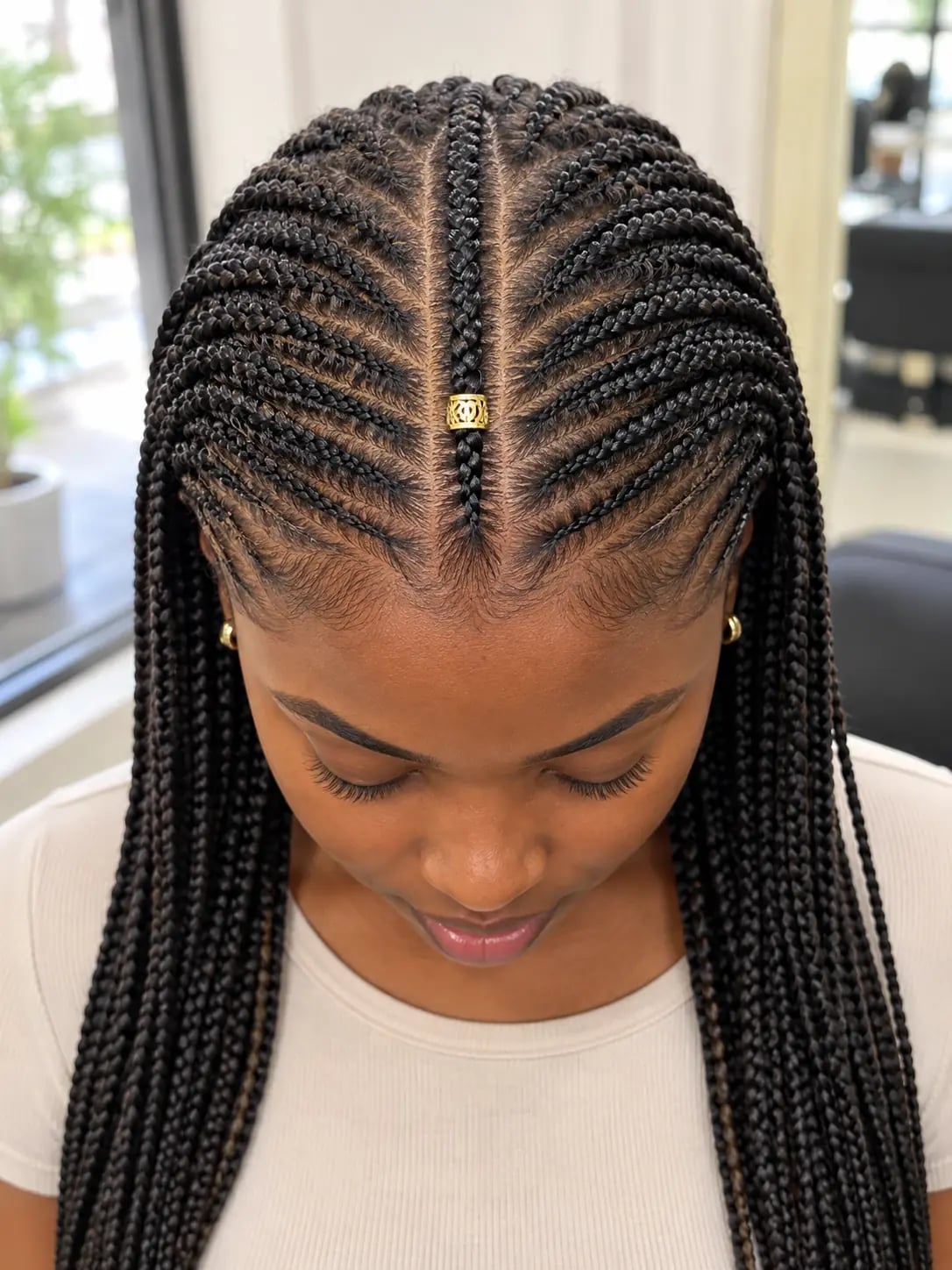
Braids worked to the back are a way to organize hair into clean lines, from geometric cornrow partings to simple three-strand plaits. The current version leans into glossy natural texture and lived-in color, so the pattern reads clearly instead of sitting flat under heavy product.
These 20 Braids to the Back Styles run from low-upkeep two-braid looks to long box braids and braided buns that need a real appointment. Fine hair, coily texture, and a round face all have options here. If your braids frizz by day three or your part never stays sharp, the answer is in the tension and the finish, not another layer of gel.
Neat Cornrows With Geometric Parting
A geometric parting turns a standard set of cornrows into a deliberate design statement, with neat braids extending down to mid-back and a few coily pieces left loose around the face. This pattern suits thick, coily hair that can hold a tight braid without slipping, and it is not a style you attempt without a skilled hand. Ask your stylist for: tight cornrows with a geometric parting, mid-back length. Allow those tendrils to air-dry or diffuse for definition, and keep the scalp moisturized with a light mist between visits.
Straight Black Braids With Geometric Pattern

Straight black braids with a geometric scalp pattern create an architectural look. The braids fall straight to mid-back with small curled tendrils by the face, a sculpted option for thick, straight hair that calls for precision. Ask your stylist for: straight braids with a geometric scalp pattern, mid-back length. A touch of pomade on the tendrils keeps them polished, and a satin bonnet at night preserves the smoothness.
Uniform Cornrows Straight Back

How do you get cornrows that sit as evenly as these? The trick is in the request. Uniformly thick black cornrows run straight back from the hairline to mid-back with a clean middle part, relying on even tension from root to end. Ask your stylist for: straight back cornrows, mid-back length, middle part. This is a salon-only style, suitable for thick, straight hair that can handle the tension.
Two Cornrows With Glossy Finish

Two thick cornrows braided down the back with a glossy finish keep the look simple without sacrificing shine. The dark black hair catches light evenly along the length, and the secured ends mean less fuss during the week. Ask your stylist for: two thick cornrows, mid-back length, glossy finish. A silk scarf at night protects that gloss better than a cotton pillowcase ever will.
Long Straight Black Braids

Straight black braids at mid-back length read best when the cornrow scalp work is as clean as the braids themselves. A middle part keeps the symmetry, and the length works for those who prefer a polished, everyday style. Ask your stylist for: long straight black braids, mid-back, cornrow scalp. A lightweight serum on the braids adds shine without weight, and a wide-tooth comb keeps the individual braids from tangling.
Reddish-Brown Cornrow Braids

A sleek black braid does the job quietly. Reddish-brown braids announce the season before the weather does, and that is the point. Long, straight braids reach mid-back, with a neat cornrow front that switches into individual braids and a middle parting down the crown. Ask your stylist for: reddish-brown braids, cornrow front to individual, mid-back. The color is the draw here, so treat it like one: a color-safe shampoo and conditioner keep the warm tone from washing out, and a scarf or a hat in strong sun slows the fade. Straight hair types carry this texture without a fight. Book it in late summer when the red reads bright, or in autumn when it settles into the brown. Either way, it is a salon appointment, not a kitchen-table project.
Shoulder-Length Box Braids With Curly Ends

The design puts all its weight at the bottom: thick black box braids, a clean middle parting, and loose wavy ends that curl out where the braid stops. Baby hairs are laid along the hairline, which keeps the front looking finished. Ask your stylist for: shoulder-length box braids with loose curly ends, baby hairs. Thick hair holds the braid structure well, and shoulder length sits above the collarbone, so it works with most face shapes. Now the trade: those curly ends are the first thing to frizz. Humidity, a hood, a pillow, and the wave starts to look fuzzy rather than defined. A curl cream on the ends and a regular trim of any stragglers keep the shape honest. If you want a style that looks the same on day one and day ten, this is not it.
Box Braids With Voluminous Curly Ends

Can you build this at home? You can try, and the ends will tell on you. Thin box braids run to mid-back and then open into long, voluminous curls, with curtain bangs framing the front and a middle parting holding the shape. The contrast is the whole trick: tight braid above, loose curl below, thick and curly throughout. Ask your stylist for: thin box braids to mid-back with long curly ends, curtain bangs.
Curtain bangs soften an angular face, and thick curly hair gives the volume something to sit on. The braiding itself is a two-hands-and-a-mirror job for most people; the curl placement at the ends is where a salon earns its time, since each section has to be set so the volume falls evenly rather than clumping on one side. A leave-in conditioner on the ends and fingers instead of a brush keep the curls separated. This is a going-out style with a long setup, so plan the appointment around a free afternoon.
Multi-Toned Box Braids

Three tones in one braid is a placement problem before it is a color one. Thick box braids run to mid-back with blonde, brown and blue worked through the length, a middle parting at the crown, and a dense, slightly wavy texture that gives the color somewhere to land. The braider decides where each tone sits: a blonde section near the face, brown through the middle, blue at the tips, or a mix wound through individual braids so the color shifts as the head moves. Ask your stylist for: box braids with blonde, brown, and blue highlights, mid-back length.
Bring references for the ratio, not just the shades, because the balance is what separates a deliberate mix from a random one. Thick hair carries multiple tones without the braids looking thin. Cool water and color-safe products protect the blue especially, since it fades faster than the blonde and brown beside it. Chlorine and saltwater are the enemies here.
Dark Brown Braids With Blonde Highlights

Twisted braids in dark brown run to mid-back, with blonde highlights threaded through a wavy texture. Ask your colorist for: dark brown twisted braids with blonde highlights, mid-back. The upkeep is the real subject. Blonde against a dark brown base shows every bit of grow-out, and braids hide the root line for a few weeks at most before the contrast starts to look uneven. Wavy hair holds the twist pattern well, and this length works with a center part. A texturizing spray keeps the waves from collapsing between appointments, and a toning session every six to eight weeks keeps the blonde from drifting brassy. Plan on a colorist who can match the highlight placement to how the braids fall.
Small Box Braids With Amber Beads

Translucent amber beads turn a standard set of small box braids into something you can hear coming. The middle parting sends those shoulder-length braids forward, so the beads land where you can see them. Coily, thick hair holds the small sections best, and the beads need real density to sit without sliding. Fine hair tends to lose the braids inside the beads. Ask your stylist for: small box braids with amber beads, shoulder length. Beads are fastened at the salon and handled gently afterward, since a dislodged one means a loose braid until the next appointment.
Collarbone Length Cornrows

Collarbone length cornrows end where a mid-back set begins to get heavy. The braids run straight back from the hairline and stop at the collarbone, with the ends tucked away, so nothing swings loose behind you. That shorter finish keeps the sculpted look close to the head and out of your way. A long braided set pulls at the nape and takes longer to dry after washing; this one clears a collar and a coat hood without a fight. Thick, straight hair gives the cleanest lines here, and the middle parting keeps the pattern symmetrical. Ask your stylist for: collarbone length cornrows, straight back. If you want movement and a braid you can flip, go longer. If you want a braid that stays put through a workday, this is the cut.
Cornrows With Low Bun and Curly Tendrils

What do you wear to a warm-weather event when you want your hair off your neck but not scraped back? Cornrows braided straight back and gathered into a low bun at the nape, with a few curly tendrils left loose at the face. The intricate parting pattern does the decorative work, so the bun can stay simple. Mid-back length gives the braids enough to wrap into the bun without pinning shortcuts. Thick, coily hair holds the tendril curl through heat and a long evening. Ask your stylist for: cornrows straight back into a low bun, with face-framing tendrils. Secure the bun with pins and hairspray before you leave the house, and mist the tendrils so they keep their shape.
Cornrows Into A Crowned Bun

The braids converge at the crown in a sharp geometric pattern, then gather into a neat bun at the nape. From the back, the design forms one continuous line, which is the point of paying for a pattern this precise. It also takes time: expect a long salon appointment and a stylist who has braided geometric work before. Thick, straight hair gives the crispest sections. Ask your stylist for: cornrows braided into a neat bun with a geometric pattern. If you have a low tolerance for sitting still, a simpler set will serve you better.
Cornrows Extending Down The Back

Cornrows that run from the hairline all the way down the back keep the middle parting visible and the coily texture on show. The braids follow the head and then continue past the shoulders, so the pattern stays readable at mid-back length. Thick, coily hair carries this style well because the natural texture gives each row something to grip. Ask your stylist for: cornrows down the back, middle part, for coily hair. Bring the length in inches or in body landmarks, not in vague terms, and say if you want the rows fine or wide. A moisturizing oil on the scalp and along the braids keeps the sections supple between appointments, and tension should never pull at the hairline. Book a braider who works with coily hair regularly, since the finish depends on even, consistent rows.
Brown Fishtail Braid With Highlights

A fishtail braid weaves two strands in a repeating pattern that looks more intricate than a standard three-strand plait. The technique works best on wavy hair with enough grip to hold the sections in place, and mid-back length gives the pattern room to travel. Ask your stylist for: brown fishtail braid with highlights, mid-back length. Gently tug each section outward after braiding to double the visible width and soften the edges. A texturizing spray before you start keeps the strands from slipping.
Thick French Braid

A French braid that runs straight down the back relies on even tension and a good amount of hair to keep its shape. Thick, straight hair is ideal here because it does not fight the plait or create gaps along the way. Ask your stylist for: thick French braid, mid-back length. Braiding on damp hair gives you more control over each section, and wrapping a small piece of hair around the end elastic hides the hardware cleanly. The hold is solid for a full day of wear, and a light spritz of holding spray stops flyaways from forming. A trim every eight weeks keeps the ends blunt enough to braid without fraying.
Dutch Braids Into Low Ponytail With Scarf

Can a braided style also function as a headband? Two Dutch braids that start at the hairline and meet at the nape create that effect, with the added utility of a low ponytail for the remaining length. Thick, wavy hair has enough body to keep the braids from looking skimpy, and the scarf at the base adds a visual anchor that also holds the ponytail in place. Ask your stylist for: two Dutch braids into a low ponytail, with a colorful scarf. The braids should be even and pulled tight against the scalp for a clean finish that lasts through movement.
High Braided Ponytail

A high braided ponytail is a gathered set of box braids swept upward, which cuts down the styling time compared to a full-head braid. Neat edges along the hairline and a middle parting give it a finished look. Ask your stylist for: high braided ponytail, mid-back length. Doing it at home requires a good elastic and patience to gather each braid evenly; a salon version ensures the tension is consistent and the base sits exactly where you want it. Wrapping a few braids around the elastic hides the band without extra accessories.
Braided Ponytail With Coily Texture

Multiple braids swept into a high ponytail let coily texture stay visible while keeping the hair off the face and neck. The trade-off is that coily hair at the base of the ponytail can dry out faster than the rest, so a moisturizing spray on the ponytail itself helps maintain definition. Ask your stylist for: high braided ponytail for coily hair, mid-back length. The style works for everyday wear because it does not require constant adjustment, but the ends may need a trim every six to eight weeks to prevent fraying and keep the ponytail looking full.
Final Thoughts
Intricate cornrow patterns and geometric partings call for a professional braider. Simpler braids and braided updos are a fair DIY test: judge your dexterity and the time you can give, and add extensions if you want more length or volume.
- Spray or oil the scalp weekly, especially along the hairline.
- Sleep on silk or satin to cut friction at the edges.
- Skip tight pulling and over-styling to avoid tension.
- Trim stray flyaways with small scissors or a light gel.
- Wash colored braids with color-safe shampoo to hold the tone.
Braids to the back offer endless possibilities for style and practicality.