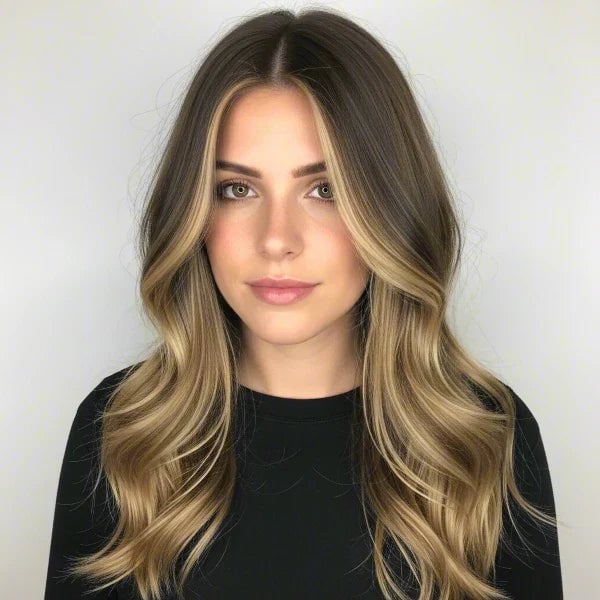
Highlighting hair means placing lighter pieces through a cut so the shape and the color do the same work: dimension follows the layers, the fringe, the baseline. Curtain bangs and soft face-framing layers drive the current version, and lived-in color keeps the grow-out line soft instead of striped.
This list runs through 17 ideas, from a chin bob to mid-back curls, with low-upkeep balayage at one end and bold blonde at the other. Fine hair that falls flat, a fringe that will not sit, a root line that shows at week five: each one gets a cut and a placement that answers it. Highlighting Hair works best when the tone is chosen for the shape, not bolted on after.
Collarbone Lob With Curtain Bangs
Wondering how to get that soft, face-framing look without committing to a full fringe? This collarbone lob with curtain bangs is the answer, blending a medium brown base with blonde highlights that catch the eye. The wavy blowout adds movement, while the curtain bangs sweep outward to soften round and heart face shapes. Ask your stylist for a collarbone lob with soft curtain bangs and blonde highlights. It suits medium density hair starting at collarbone length, and the layers blend seamlessly into the bangs for a cohesive finish.
Textured Shag With Wispy Bangs

The textured shag is a lesson in controlled chaos, with shoulder-length layers and wispy bangs that frame the face. Styled in textured waves, it thrives on thick hair that can hold its shape. The medium brown base with blonde highlights adds depth, making the cut look lived-in rather than freshly done. This one is for those with naturally wavy or slightly straight textures who want movement without daily styling. Ask your stylist for a textured shag with wispy bangs and blended blonde highlights. To keep the bangs from turning into a curtain, dust them every four weeks.
Collarbone Layers With Face-Framing Highlights

The trick here is placement: blonde highlights are concentrated around the face, with the dark brown base staying deeper. Long layers at collarbone length give the wavy blowout something to grip, while curtain bangs blend into the face-framing pieces. The effect is a brightening around the jawline, which softens angular features. Ask your colorist for collarbone length layers with face-framing blonde highlights and curtain bangs. It works best on medium density hair at collarbone length, and the layers keep the shape from falling flat.
Layered Lob With Side-Swept Bangs

If curtain bangs feel like too much of a commitment, side-swept bangs offer a different geometry. They draw the eye across the face, which suits oval and long face shapes by adding width at the cheekbones. This layered lob ends at the collarbone, with a dark base and blonde highlights that stay noticeable around the face. The side parting changes how the waves fall, so the lob reads as more polished than a middle-parted version. Ask your stylist for a layered lob with side-swept bangs and face-framing blonde highlights. Tuck the longer side behind your ear to switch up the silhouette; a trim every six to eight weeks keeps the bangs in check.
Ash Blonde Lob With Dimensional Highlights

Ash blonde is a commitment, and the result is a lived-in lob with a natural grow-out look. The collarbone length and subtle layers give fine to medium density hair some perceived thickness, while high-dimension highlights add movement without chunky streaks. Loose waves separate the lighter pieces into distinct ribbons of color. Ask your colorist for a collarbone lob with subtle layers and ash blonde dimensional highlights. The ash tone needs a toning appointment every six to eight weeks to stay cool, and a texturizing spray keeps the waves from falling flat.
Blunt Bob With Bold Blonde Highlights

A blunt bob is a single line drawn straight across, and thick blonde highlights on a dark brown base make that line impossible to ignore. Collarbone length with no bangs keeps the shape clean from the middle part down. Straight, medium density hair suits it; square and oval faces carry the hard baseline well. Ask your stylist for: collarbone length blunt bob with bold blonde highlights. Precision like this is a salon job, not a kitchen scissors situation. A flat iron keeps the ends sharp between trims, and the blunt baseline needs a trim every six weeks before it starts to fray.
Collarbone Waves With Ash Blonde Highlights

Soft waves through a smooth blowout keep the contrast from looking striped. Medium density wavy hair holds this shape without much coaxing, and no bangs means nothing competes with the color. It works in fall and winter, when cooler tones sit right, and it suits an evening out without changing a thing. Ask your stylist for: collarbone length layers with contrasting ash blonde highlights. Ash fades toward brass quickly, so plan a salon toning visit every six to eight weeks to hold the cool edge.
Collarbone Layers With Golden Highlights

What makes golden highlights work on a blonde base? Placement, mostly: they sit where light hits the loose waves, so the warmth shows up as depth instead of a flat block of color. Soft layers cut through collarbone length give those waves somewhere to bend, and a side part keeps the front from falling heavy. Medium density wavy hair is the right starting point. Ask your stylist for: collarbone length layers with subtle golden highlights. A wave-enhancing serum scrunched through damp ends holds the shape without crunch, and layers at this length grow out quietly, so a trim every eight to ten weeks keeps the outline.
Collarbone Layers With Pastel Highlights, Wavy

Pastel highlights need a base with something to push against, and a brown base with ash blonde and rose gold pieces through collarbone length long layers gives them that. Medium density wavy hair carries the loose waves without the color pooling at the ends. This suits anyone starting from a mid-brown base whose hair has been kept light enough to lift; if the base is dark or previously colored, expect more than one session. Ask your stylist for: long layers with ash blonde and rose gold highlights. Pastels wash out fast, so a color-depositing conditioner between appointments is the difference between rose gold and vaguely pink, and trims every eight to ten weeks keep the ends clean.
Stacked Bob With Voluminous Highlights

Ask for a stacked bob and you are asking for two cuts in one: shorter stacked layers at the back for lift, longer pieces toward the front for shape. At chin length with a voluminous blowout, thick wavy hair does the rest. Lighter blonde highlights on a blonde base pick out each layer, so the texture reads from across a room. Ask your stylist for:
- chin length stacked bob
- voluminous layers at the back
- lighter blonde highlights
No bangs keeps the focus on the shape. Bring a photo of the volume you want, since stacked and graduated get used loosely.
Chin Bob With Side-Swept Bangs

Fine straight hair meets its match in a chin bob with side-swept bangs. The dark base keeps it grounded, while concentrated blonde highlights around the face pull attention right where you want it. A side part adds volume at the crown without needing layers cut too short.
Fine hair this short can fall flat by midday. A blow-dryer with a round brush aimed at the roots buys you a few hours of lift. Ask your stylist for a chin-length bob with side-swept bangs and face-framing blonde highlights. Plan on a trim every four to six weeks or the bob loses its clean line fast.
Sleek Chin Bob With Contrasting Highlights

A chin bob with strong contrast works on a simple principle: the darker the base, the louder the blonde reads. Here, thick blonde pieces sit close to the scalp and travel through the lengths, making a sleek straight style look deliberate instead of flat. Ask your colorist for a chin-length sleek bob with strong blonde highlights. The sharp line of the bob suits oval and heart face shapes, though any face can wear it with the right side part.
Mid-Back Straight Hair With Subtle Highlights

Highlights a shade or two lighter than the base create depth. On a dark blonde base, thin blonde pieces woven through the hair read as natural sunlight. Long layers keep the weight in the hemline while the color shows through the surface.
Thick straight hair of mid-back length holds this shape well; fine hair may need the layers brought higher to get the same lift. Ask your colorist for a mid-back length straight cut with long layers and subtle blonde highlights. A smooth blowout with a large barrel brush pulls the shine. Trim every ten to twelve weeks to keep the ends healthy.
Mid-Back Straight With Face-Framing Layers

Face-framing layers with highlights differ from just face-framing highlights in one key way: the layers shorten the hair around the jaw and cheekbones, so the blonde pieces land closer to the face. On a dark brown base, those lighter strands catch the eye immediately. A middle part and a blowout keep the look polished rather than piecey.
Thick straight hair of mid-back length works best here; the layers need density to blend smoothly. Ask your stylist for a mid-back length straight cut with face-framing layers and blonde highlights. Use a round brush to tuck the shorter pieces under. Trim every ten to twelve weeks, though the face-framing layers may need a touch-up sooner.
Mid-Back Waves With Caramel Highlights

Caramel highlights on a dark brown base add warmth without shifting the overall tone too light. Loose waves let the caramel strands catch light at different angles, so the color looks richer than a solid gloss could manage. A middle part and thick wavy texture keep the volume balanced from root to end. Ask your colorist for a mid-back length layered cut with subtle caramel highlights. No bangs here, so the waves fall uninterrupted.
Mid-Back Curls With Auburn Highlights

Auburn highlights on thick, curly hair at mid-back length are deliberate. The dark brown base grounds each coil while the auburn slices catch light and make the curl pattern look intentional. Long layers keep the shape from turning into a triangle; without them, dense curls at this length get heavy fast. Ask your stylist for: mid-back length loose curls with long layers and subtle auburn highlights.
Red tones wash out of porous curly hair in about six weeks, so a color-depositing conditioner becomes a routine step. A trim every 10 to 12 weeks keeps the long layers from splitting, and diffusing on low heat preserves the curl without frizz. No bangs here, which means less daily styling, but the color upkeep is the trade-off.
Long Hair With Caramel Balayage

A caramel balayage on long, dark brown hair works because the technique does the blending, not the bleach. A stylist hand-paints sections from mid-length downward, leaving the root area untouched, so the transition from dark to caramel looks like the sun did it. Loose waves with a middle part show off the soft color shifts better than straight hair, which can flatten the dimension. Ask your colorist for: long hair with soft waves and caramel balayage.
This is a salon-only job. A balayage requires a colorist who understands placement and how caramel tones lift on a dark base, and that is not a bathroom-mirror skill. The grow-out typically goes three to four months without a root touch-up, which makes it practical for anyone who prefers fewer salon hours per year. The wavy texture helps camouflage any hard lines as the color grows, so the sunkissed effect stays believable.
Final Thoughts
For fine hair, keep one blunt baseline and let the highlights add the illusion of density without heavy layers. For thick hair, a balayage or face-framing pieces prevent the color from feeling overwhelming. Choose highlights that complement your cut, not compete with it.
- Schedule salon toning every 6-8 weeks to maintain highlight vibrancy.
- Use a color-safe shampoo and conditioner to prevent fading.
- Incorporate a deep conditioning treatment weekly for dry, highlighted hair.
- Trim split ends every 10-12 weeks to keep highlights looking fresh.